%%{init: {"theme":"base","themeVariables":{"fontFamily":"Inter, system-ui, sans-serif","fontSize":"16px","primaryColor":"#eef2f7","primaryTextColor":"#0f172a","lineColor":"#475569","tertiaryColor":"#e2e8f0"},"flowchart":{"curve":"basis","nodeSpacing":30,"rankSpacing":50}}}%%
flowchart LR
P["Prompts"] --> M["SFT Model πθ"]
M --> RA["Response A"]
M --> RB["Response B"]
RA --> H["Human Rater"]
RB --> H
H -->|"A ≻ B"| RM["Reward Model rθ"]
RM -->|"r(x,y)"| PPO["PPO"]
PPO -->|"Update πθ"| M
From Pretrained Model to Deployed Assistant
Alignment, Decoding, and Distillation
Robert Minneker
2026-02-12
Sources
Content derived from: J&M Ch. 8 (Transformers), Ch. 7 (Large Language Models)
Administrivia
- Project checkpoints due Today!
Learning Objectives
By the end of this lecture, you will be able to:
Explain the difference between training-time, inference-time, and deployment-time control in LLMs
Implement and compare decoding algorithms
Describe how alignment (SFT, RLHF, DPO) modifies model behavior
Explain how distillation enables efficient deployment
Today’s roadmap
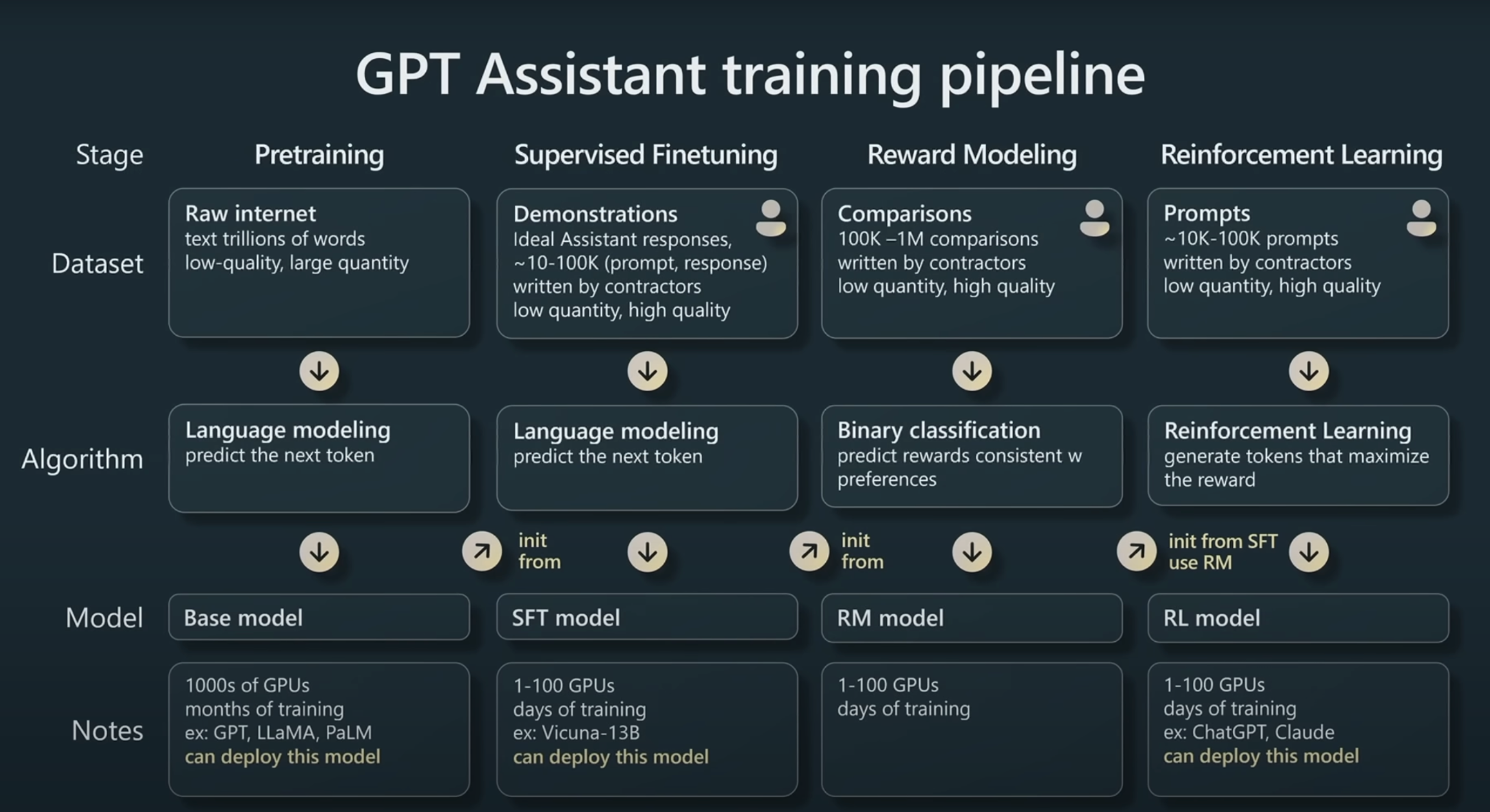
Karpathy (2023): GPT Assistant Training Pipeline
Last time: Pretraining (Stage 1). Today: everything after.
- Part 5: Instruction Tuning (SFT) — teaching the model to follow instructions
- Part 6: RLHF & DPO — aligning with human preferences
- Part 7: Decoding Algorithms — how LLMs actually generate text
- Part 8: Knowledge Distillation — deploying smaller models
Part 5: Instruction Tuning
Base models complete text — they don’t follow instructions
Base Model
Prompt: "Summarize this article: The economy grew..."
"...by 3.2% in the third quarter, beating analyst expectations. Experts say this trend is likely to continue..."
Continues the article instead of summarizing
Instruction-Tuned Model
Prompt: "Summarize this article: The economy grew..."
"The article reports that the economy expanded by 3.2% in Q3, exceeding expectations due to strong consumer spending."
Actually summarizes as instructed
Supervised Fine-Tuning (SFT) on instruction-response pairs
Training data format:
Instruction: Translate "Hello, how are you?" to French.
Response: "Bonjour, comment allez-vous?"
SFT objective:
\[ \mathcal{L}_{\text{SFT}} = -\sum_{i=1}^{N} \log P_\theta(y_i \mid x_i) \]
- \(x_i\): instruction (input)
- \(y_i\): desired response (output)
- Same cross-entropy loss, but on curated instruction data
Instruction tuning: Implementation details
Formatting data for instruction-tuned models:
# For summarization with instruction-tuned models
def prepare_for_summarization(article, tokenizer):
    prompt = f"Summarize the following article.\n\n{article}\n\nTL;DR:"
    return tokenizer(prompt, return_tensors="pt")

# System prompts set the model's "persona"
system_prompt = "You are a helpful assistant and an expert at summarizing articles."
Fine-tuning with label masking (for training summarization models):
Large models are expensive to deploy
70B+
parameters in frontier models
$$$
GPU costs for serving
High latency
slow responses at scale
We want similar quality at lower cost.
Preview: Knowledge Distillation (Part 8)
We can train a smaller “student” model to mimic the large model’s behavior — getting most of the quality at a fraction of the cost.
Before turning to efficiency, we’ll address a deeper limitation of SFT: It only learns from one correct answer per instruction. Can we do better?
Part 6: Preference Alignment with RLHF
Why RLHF? SFT isn’t enough
SFT limitations:
- One "correct" answer per instruction
- Can't encode preferences between valid responses
- Expensive to write high-quality responses
- May learn to imitate surface patterns
RLHF advantages:
- Captures human preferences between options
- Easier to judge than to write
- Learns subtle quality distinctions
- Optimizes for what humans actually want
Key insight: It’s easier to say “A is better than B” than to write the perfect A.
RLHF: The three-step process
1
Collect Preference Data
For each prompt, generate multiple responses. Humans rank: A > B or B > A
↓
2
Train Reward Model
Learn to predict human preferences: r(x, y) → scalar score
↓
3
Optimize LLM with RL
Use PPO to maximize expected reward while staying close to SFT model
RLHF data flow
The reward model is a learned proxy for human judgment — it scores responses so we don’t need a human in the loop at training time.
Reward model intuition: Learning from comparisons
Prompt: "Explain gravity to a 5-year-old"
Response A ✓ preferred
"Gravity is like an invisible magnet in the Earth that pulls everything down — that's why when you jump, you come back!"
"Gravity is like an invisible magnet in the Earth that pulls everything down — that's why when you jump, you come back!"
Response B
"Gravity is a fundamental force described by general relativity as the curvature of spacetime caused by mass-energy..."
"Gravity is a fundamental force described by general relativity as the curvature of spacetime caused by mass-energy..."
Reward model assigns scores: r(A) = 2.4, r(B) = 0.8
P(A ≻ B) = σ(2.4 − 0.8) = σ(1.6) ≈ 0.83
P(A ≻ B) = σ(2.4 − 0.8) = σ(1.6) ≈ 0.83
This intuition leads to the Bradley-Terry model →
Training the reward model
Bradley-Terry preference model:
\[ P(A \succ B) = \sigma(r_\theta(x, y_A) - r_\theta(x, y_B)) \]
Reward model loss:
\[ \mathcal{L}_{\text{RM}} = -\mathbb{E}_{(x, y_w, y_l)} \left[ \log \sigma(r_\theta(x, y_w) - r_\theta(x, y_l)) \right] \]
- \(y_w\): preferred (winning) response
- \(y_l\): dispreferred (losing) response
- \(\sigma\): sigmoid function
The reward model learns to assign higher scores to preferred responses.
Optimizing the LLM with reinforcement learning
Objective:
\[ \max_\theta \mathbb{E}_{y \sim \pi_\theta(y|x)} [r(x, y)] - \beta \cdot \text{KL}[\pi_\theta \| \pi_{\text{ref}}] \]
Reward Maximization
E[r(x, y)]
Generate responses that score high
KL Penalty
-β · KL[π || πref]
Don't deviate too far from SFT model
- PPO (Proximal Policy Optimization) is commonly used
- KL penalty prevents “reward hacking”
From RLHF to DPO: What changes?
RLHF
- Train a separate reward model
- Run PPO optimization loop
- Complex, unstable training
- Three separate stages
→
DPO
- No reward model needed
- No RL loop required
- Directly optimize preference pairs
- Standard supervised learning
Key insight: Same preference data, dramatically simpler training.
Alternatives to RLHF: Direct Preference Optimization
Key insight: The optimal RLHF policy has a closed-form relationship with the reward model. DPO exploits this to optimize directly on preference pairs — no reward model or RL needed.
DPO loss (Rafailov et al., 2023):
\[ \mathcal{L}_{\text{DPO}} = -\mathbb{E}\left[\log \sigma\left(\beta \log \frac{\pi_\theta(y_w|x)}{\pi_{\text{ref}}(y_w|x)} - \beta \log \frac{\pi_\theta(y_l|x)}{\pi_{\text{ref}}(y_l|x)}\right)\right] \]
Reading the formula: increase the probability of the preferred response \(y_w\) (relative to the reference model) and decrease the probability of the dispreferred response \(y_l\).
RLHF
Preferences → Reward Model → RL
Complex, unstable, expensive
DPO
Preferences → Direct optimization
Simpler, stable, supervised learning
Alignment goals: Helpful, Harmless, Honest
Helpful
Answers questions effectively
Completes requested tasks
Provides useful information
Completes requested tasks
Provides useful information
Harmless
Refuses dangerous requests
Avoids harmful content
Doesn't assist malicious use
Avoids harmful content
Doesn't assist malicious use
Honest
Acknowledges uncertainty
Doesn't make things up
Corrects mistakes
Doesn't make things up
Corrects mistakes
Tension
These goals can conflict: A helpful answer to a harmful request is itself harmful.
Concept check
Quick questions (think for 30 seconds):
- In the RL objective, what happens if we set β = 0?
- An RLHF-trained chatbot starts adding “As an AI language model…” to every response. What went wrong?
RL Objective reminder: \[ \max_\theta \mathbb{E}_{y \sim \pi_\theta(y|x)} [r(x, y)] - \beta \cdot \text{KL}[\pi_\theta \| \pi_{\text{ref}}] \]
From training to generation
We’ve covered how LLMs are trained to be helpful:
- Pretraining — learn language from raw text
- SFT — learn to follow instructions (Part 5)
- RLHF/DPO — align with human preferences (Part 6)
Now: how do they actually generate text?
Given a trained model and a prompt, how do we produce an output — one token at a time?
But note: what you put in matters as much as how tokens come out. We’ll cover the output side today (decoding), and the input side next time (prompting, in-context learning, reasoning).
Three control knobs in LLM systems
Training-time
(change weights)
- SFT
- RLHF
- DPO
Inference-time
(change decoding)
- Greedy
- Temperature
- Top-k / Top-p
Deployment-time
(change size)
- Knowledge distillation
These mechanisms operate on different axes but interact in final behavior.
Training vs. inference: Different levers
Training (shapes probabilities)
- Alignment modifies the token distribution
- Changes relative likelihoods
Inference (selects from distribution)
- Decoding determines which tokens get chosen
These interact in practice:
- Greedy decoding can amplify repetitive artifacts from training
- High temperature increases hallucination risk regardless of alignment
- Beam search often reduces diversity even in well-aligned models
Part 7: Text Generation and Decoding
The autoregressive generation loop
def generate(model, prompt_ids, max_new_tokens=50):
    input_ids = prompt_ids

    for _ in range(max_new_tokens):
        # Forward pass: get logits for all positions
        logits = model(input_ids)  # (B, seq_len, vocab_size)

        # Extract logits for the LAST position only
        next_token_logits = logits[:, -1, :]  # (B, vocab_size)

        # DECODE: Select next token (this is where methods differ!)
        next_token = decode(next_token_logits)

        # Append and continue
        input_ids = torch.cat([input_ids, next_token.unsqueeze(1)], dim=1)

    return input_ids
The decode() function is where greedy, sampling, top-k, and top-p differ!
Decoding as search in sequence space
Greedy
Local argmax — pick the best token at each step
Beam search
Approximate global argmax — track top-B sequences
Sampling
Stochastic search — randomness enables exploration
Top-p
Entropy-aware truncation — adapt randomness to confidence
Generating text is approximate search over an exponential space.
Why does the decoding method matter?
Prompt: “The city of Paris is”
Greedy decoding:
"The city of Paris is the capital of France. The capital of France is the capital of France. The capital of France is the capital of..."
→ Repetitive loops
Pure sampling:
"The city of Paris is accordion Tuesday gravel. Momentum faintly bicycle the whiskers of launching..."
→ Incoherent (low-probability tokens sampled)
Nucleus sampling (p=0.9):
"The city of Paris is known for its stunning architecture, world-class museums, and vibrant café culture that draws millions of visitors..."
→ Fluent and diverse
The challenge: find the sweet spot between coherence and diversity.
Greedy decoding: Always pick the most likely token
\[\hat{w}_t = \arg\max_{w} P(w \mid w_1, \ldots, w_{t-1})\]
Advantages:
- Deterministic (reproducible)
- Fast (no sampling)
- Often coherent
Limitations:
- Repetitive outputs
- No diversity
- Can get stuck in loops
Vanilla sampling: Sample from the distribution
\[w_t \sim P(w \mid w_1, \ldots, w_{t-1})\]
softmaxconverts logits to probabilitiesmultinomialsamples from the categorical distribution- Each run produces different output
Problem with Pure Sampling
Low-probability tokens can still be selected, leading to incoherent text:
“The capital of France is accordion…”
Temperature sampling: Control randomness
\[P_T(w) = \frac{\exp(z(w)/T)}{\sum_{w'} \exp(z(w')/T)}\]
| Temperature | Effect | Distribution |
|---|---|---|
| T → 0 | More deterministic | Approaches greedy |
| T = 1 | Original distribution | Standard sampling |
| T > 1 | More random | Flatter distribution |
Temperature effects visualized
Original logits: [4.0, 2.0, 1.0, 0.5]
T = 0.5 (sharper)
probs ≈ [0.88, 0.09, 0.02, 0.01]
T = 1.0 (original)
probs ≈ [0.64, 0.24, 0.09, 0.05]
T = 2.0 (flatter)
probs ≈ [0.42, 0.26, 0.18, 0.14]
Top-k sampling: Only consider the k best tokens
def topk(logits, k=50):
    """Sample from only the top k tokens"""
    # Get top k logits and their indices
    top_logits, top_indices = torch.topk(logits, k, dim=-1)

    # Sample from the top k
    probs = F.softmax(top_logits, dim=-1)
    sampled_idx = torch.multinomial(probs, num_samples=1)

    # Map back to vocabulary indices
    return torch.gather(top_indices, -1, sampled_idx).squeeze(-1)
Idea: Truncate the long tail of unlikely tokens, then sample from the rest.
k = 50: Sample from top 50 tokens only
k = 1: Equivalent to greedy decoding
k = 1: Equivalent to greedy decoding
Visualizing truncation: top-k vs top-p
Same distribution, different truncation:
Top-k (k=3): Fixed — always 3 tokens
the
.40
.40
a
.25
.25
one
.15
.15
an
.10
.10
my
.05
.05
...
.05
.05
Covers 80% of probability mass
Top-p (p=0.9): Adaptive — cumsum ≥ 0.9
the
.40
.40
a
.25
.25
one
.15
.15
an
.10
.10
my
.05
.05
...
.05
.05
Covers 90% of probability mass (4 tokens)
Top-k misses “an” (10% probability) because it always takes exactly k. Top-p includes it because 90% mass hasn’t been reached yet.
Top-p (nucleus) sampling: Adaptive truncation
Idea: Keep the smallest set of tokens whose cumulative probability ≥ p
Algorithm (Holtzman et al., 2020):
- Sort tokens by probability (highest first)
- Compute cumulative probabilities
- Find the cutoff where cumulative probability exceeds p
- Zero out all tokens beyond the cutoff
- Sample from the remaining tokens
Top-p implementation
def topp(logits, p=0.9):
    """Nucleus sampling: dynamic truncation based on cumulative probability"""
    # Step 1: Sort by probability (descending)
    sorted_logits, sorted_indices = torch.sort(logits, descending=True, dim=-1)
    sorted_probs = F.softmax(sorted_logits, dim=-1)

    # Step 2: Compute cumulative probabilities
    cumsum_probs = torch.cumsum(sorted_probs, dim=-1)

    # Step 3-4: Find and apply cutoff
    sorted_indices_to_remove = cumsum_probs > p
    # Tricky: shift right so we INCLUDE the token that crosses p
    sorted_indices_to_remove[..., 1:] = sorted_indices_to_remove[..., :-1].clone()
    sorted_indices_to_remove[..., 0] = False  # Always keep at least one token

    sorted_logits[sorted_indices_to_remove] = float('-inf')

    # Step 5: Sample from remaining tokens
    probs = F.softmax(sorted_logits, dim=-1)
    sampled_idx = torch.multinomial(probs, num_samples=1)
    return torch.gather(sorted_indices, -1, sampled_idx).squeeze(-1)
The right-shift trick (lines 8–9)
Without the shift, we’d exclude the token that crosses the threshold. The shift ensures the nucleus always covers at least p probability mass.
Top-p example: Adaptive behavior
Confident prediction (peaked)
probs: [0.70, 0.15, 0.08, 0.04, 0.03]
cumsum: [0.70, 0.85, 0.93, 0.97, 1.0]
cumsum: [0.70, 0.85, 0.93, 0.97, 1.0]
p=0.9 → keep 3 tokens
Uncertain prediction (flat)
probs: [0.25, 0.20, 0.18, 0.15, 0.12, 0.10]
cumsum: [0.25, 0.45, 0.63, 0.78, 0.90, 1.0]
cumsum: [0.25, 0.45, 0.63, 0.78, 0.90, 1.0]
p=0.9 → keep 5 tokens
Key advantage over top-k: The “effective k” adapts to the distribution!
Concept check
Quick questions (think for 30 seconds):
- What happens to entropy as temperature increases?
- When does top-k approximate top-p?
- Why might greedy decoding increase repetition?
Comparing decoding methods
| Method | Diversity | Coherence | Deterministic? | Best for |
|---|---|---|---|---|
| Greedy | Low | High | Yes | Code, factual QA |
| Temperature (low) | Low | High | No | Slight variation |
| Temperature (high) | High | Low | No | Brainstorming |
| Top-k | Medium | Medium-High | No | General use |
| Top-p | Medium | High | No | Dialogue, creative |
In practice: Top-p (p=0.9) with temperature (t=0.7-0.9) is a common default.
What about beam search?
Beam search keeps the top-B most likely sequences at each step (not just tokens).
Still used for:
- Machine translation
- Summarization
- Tasks with a single "correct" output
Less used for open-ended generation:
- Tends to produce bland, generic text
- Maximizes likelihood ≠ maximizes quality
- Sampling methods preferred for dialogue
Modern LLM APIs (ChatGPT, Claude) use sampling-based methods, not beam search.
Generation evaluation metrics
Perplexity (lower = better): \[\text{PPL} = \exp\left(-\frac{1}{N}\sum_{i=1}^N \log P(w_i \mid w_1, \ldots, w_{i-1})\right)\]
Perplexity
Measures naturalness
"How surprised is the model?"
"How surprised is the model?"
Fluency
Grammatical acceptability
(e.g., CoLA classifier)
(e.g., CoLA classifier)
Diversity
Unique n-grams ratio
(higher = more varied)
(higher = more varied)
How decoding methods affect metrics
| Method | Perplexity | Fluency | Diversity |
|---|---|---|---|
| Greedy | Best | High | None |
| High temperature | Worse | Lower | High |
| Top-p (p=0.9) | Good | High | Good |
Top-p gives the best balance — good perplexity and diversity without sacrificing fluency.
Part 8: Knowledge Distillation
From research model to production system
Alignment
improves behavior
→
Decoding
controls generation
→
Deployment
requires efficiency
→
Distillation
enables practical serving
Distillation is deployment engineering — it doesn’t change what the model knows, but makes it practical to serve.
Knowledge distillation: training smaller models from larger ones
Core idea: A small “student” model learns to mimic a large “teacher” model
Teacher
70B parameters
High quality
Slow inference
High quality
Slow inference
→
Soft Labels
P(token | context)
→
Student
7B parameters
Good quality
Fast inference
Good quality
Fast inference
Why soft labels? They encode richer information
Hard label (one-hot): \[P(\text{next token}) = [0, 0, 1, 0, 0, \ldots]\]
Soft label (teacher distribution): \[P(\text{next token}) = [0.01, 0.15, 0.60, 0.12, 0.08, \ldots]\]
Example: "The cat sat on the ___"
Hard label:
mat: 1.0
everything else: 0.0
everything else: 0.0
Soft label (from teacher):
mat: 0.45, rug: 0.20
floor: 0.15, couch: 0.08...
floor: 0.15, couch: 0.08...
Soft labels teach: "rug is similar to mat, floor is plausible too"
The distillation loss combines hard and soft targets
Training objective:
\[ \mathcal{L}_{\text{distill}} = \alpha \cdot \mathcal{L}_{\text{soft}} + (1-\alpha) \cdot \mathcal{L}_{\text{hard}} \]
where:
\[ \mathcal{L}_{\text{soft}} = -\sum_i P_T^{(\tau)}(i) \log P_S^{(\tau)}(i) \]
\[ P^{(\tau)}(i) = \frac{\exp(z_i / \tau)}{\sum_j \exp(z_j / \tau)} \]
- \(\tau\) = temperature (same concept as Part 7! Higher → softer, reveals more structure)
- \(P_T\) = teacher probability, \(P_S\) = student probability
- \(\alpha\) balances learning from teacher vs. ground truth
Distillation training loop
# Knowledge distillation training loop (simplified)
for articles, reference_summaries in dataloader:
    # Teacher generates soft labels (no gradient needed)
    with torch.no_grad():
        teacher_logits = teacher_model(articles, reference_summaries)

    # Student predicts
    student_logits = student_model(articles, reference_summaries)

    # Soft loss: match teacher's distribution (with temperature)
    soft_loss = F.kl_div(
        F.log_softmax(student_logits / tau, dim=-1),
        F.softmax(teacher_logits / tau, dim=-1),
        reduction="batchmean"
    ) * (tau ** 2)  # Scale factor corrects for temperature

    # Hard loss: standard cross-entropy on ground truth
    hard_loss = F.cross_entropy(student_logits, reference_summaries)

    # Combined loss
    loss = alpha * soft_loss + (1 - alpha) * hard_loss
loss.backward()Distillation in practice: notable examples
| Student Model | Teacher | Key Benefit |
|---|---|---|
| DistilBERT | BERT-base | 40% smaller, 60% faster, 97% performance |
| TinyLlama (1.1B) | LLaMA-7B | Mobile-friendly, strong performance |
| Gemma 2B | Larger Gemma | Efficient on-device deployment |
| Phi-3 | GPT-4 (synthetic data) | High capability in small package |
In Assignment 3: You’ll use Qwen-1.5B (teacher) to generate synthetic summaries, then fine-tune GPT-2 124M (student) on them.
Summary: From pretrained model to deployed assistant
We traced the full path from a pretrained LLM to a deployed assistant:
- Instruction Tuning (SFT): Teach the model to follow instructions using curated data
- RLHF / DPO: Align with human preferences using pairwise comparisons
- Decoding: Generate text with greedy, temperature, top-k, or top-p sampling
- Knowledge Distillation: Compress large models into smaller, deployable students
Tip
These are three independent control axes that together determine real-world model behavior. (Training, Inference, and Deployment)
Coming up next
We built the model and learned how it generates text. But how you use it matters enormously:
- Prompting strategies: Zero-shot, few-shot, and chain-of-thought
- In-context learning: How LLMs learn from examples in the prompt — without any gradient updates
- Reasoning: Can LLMs solve multi-step problems? When and why do they fail?
Today: We control the output (decoding algorithms)
Next: We control the input (prompting and reasoning)
Next: We control the input (prompting and reasoning)
CSE 447/517 26wi - NLP