Attention and the Transformer Architecture
2026-02-05
Sources
Content derived from: J&M Ch. 8 (Transformers)
Administrivia
- Midterm feedback form is out!
- Fill out via Canvas path, instructions on Ed
- Please start A2 if you haven’t already!
Learning Objectives
By the end of this lecture, you will be able to:
- Explain why RNNs/LSTMs were replaced by attention-based architectures
- Derive and compute scaled dot-product self-attention
- Describe how multi-head attention captures diverse relationships
- Trace information flow through a transformer block
- Explain how causal masking enables autoregressive generation
Part 1: From Sequential to Parallel Processing
RNNs process sequences one token at a time
Recurrent hidden state update:
\[ h_t = f(W_{xh} x_t + W_{hh} h_{t-1} + b) \]
- Each step depends on the previous—no parallelization possible
- Information must flow through the entire chain
Sequential processing creates three critical problems
LSTMs and GRUs mitigated vanishing gradients but couldn’t solve the parallelization problem.
Attention allows direct connections between all positions
Key insight: Every token can directly “look at” every other token in a single operation.
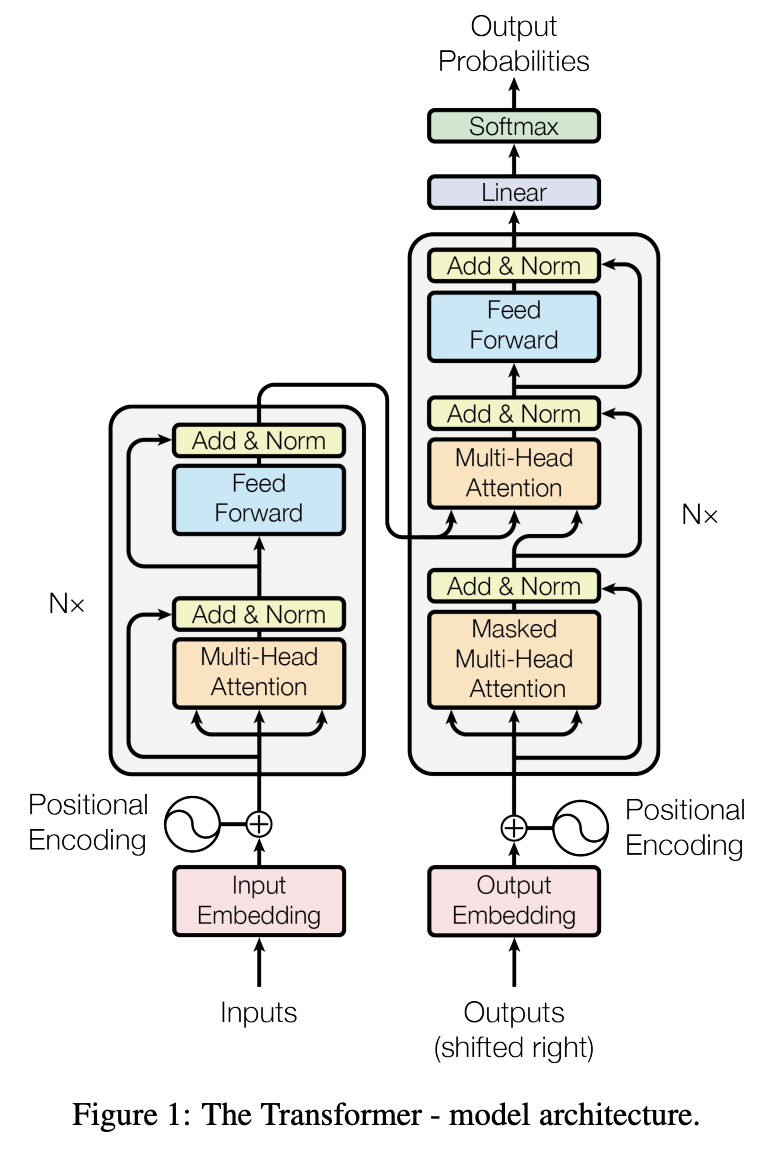
The transformer architecture revolutionized NLP in 2017
All You Need"
Claude, LLaMA
Vaswani et al. (2017): “Attention Is All You Need”
- Originally designed for machine translation
- Quickly became dominant for ALL NLP tasks
- Every modern LLM is based on the transformer architecture
Part 2: Self-Attention Mechanism
Self-attention projects each token into query, key, and value vectors
For input embedding \(\mathbf{x}_i\):
\[ \mathbf{q}_i = \mathbf{x}_i W^Q, \quad \mathbf{k}_i = \mathbf{x}_i W^K, \quad \mathbf{v}_i = \mathbf{x}_i W^V \]
- \(W^Q, W^K, W^V \in \mathbb{R}^{d \times d_k}\) are learned projection matrices
The QKV intuition: retrieval from a soft dictionary
Analogy: Like a search engine where:
- Query = your search terms
- Key = document titles/metadata
- Value = document contents
Attention scores measure relevance via dot products
\[ \text{score}(i, j) = \mathbf{q}_i \cdot \mathbf{k}_j = \mathbf{q}_i \mathbf{k}_j^\top \]
| Token j | qsat · kj | Interpretation |
|---|---|---|
| The | 0.8 | Low relevance |
| cat | 4.2 | High—subject of "sat" |
| on | 1.5 | Medium |
| the | 0.6 | Low relevance |
| mat | 3.8 | High—location of "sat" |
Scaling prevents softmax saturation
\[ \text{Attention}(Q, K, V) = \text{softmax}\left(\frac{QK^\top}{\sqrt{d_k}}\right)V \]
Why divide by \(\sqrt{d_k}\)?
The output is a weighted sum of value vectors
\[ \text{output}_i = \sum_{j=1}^n \alpha_{ij} \mathbf{v}_j \]
where \(\alpha_{ij} = \text{softmax}\left(\frac{\mathbf{q}_i \cdot \mathbf{k}_j}{\sqrt{d_k}}\right)\)
- High attention weight → that position contributes more
- Context is incorporated through this weighted aggregation
Matrix form: compute all attention outputs in parallel
\[ \text{Attention}(Q, K, V) = \text{softmax}\left(\frac{QK^\top}{\sqrt{d_k}}\right)V \]
- One matrix multiply computes all n² pairwise attention scores
- GPUs are highly optimized for matrix multiplication
- This enables massive parallelism
Part 3: Multi-Head Attention and Transformer Blocks
Multi-head attention runs several attention operations in parallel
\[ \text{head}_i = \text{Attention}(QW_i^Q, KW_i^K, VW_i^V) \]
\[ \text{MultiHead}(Q, K, V) = \text{Concat}(\text{head}_1, \ldots, \text{head}_h)W^O \]
- Each head has its own \(W^Q, W^K, W^V\) matrices
- Heads learn to specialize in different relationship types
- Typical: 8-16 heads with \(d_k = d_{\text{model}} / h\)
Different heads capture different linguistic relationships
Research finding: Attention heads in trained models often align with linguistic structure (“What Does BERT Look At? An Analysis of BERT’s Attention” Clark et al., 2019).
A transformer block combines attention with a feed-forward network
The feed-forward network processes each position independently
\[ \text{FFN}(x) = \text{ReLU}(xW_1 + b_1)W_2 + b_2 \]
or with GELU (used in GPT-2+):
\[ \text{FFN}(x) = \text{GELU}(xW_1)W_2 \]
- No interaction between positions—applied identically to each token
- Expands to 4× dimension, then projects back
Residual connections and layer normalization stabilize training
Residual connection: \[ \text{output} = \text{sublayer}(x) + x \]
Layer normalization: \[ \text{LayerNorm}(x) = \gamma \cdot \frac{x - \mu}{\sigma + \epsilon} + \beta \]
- Gradient flows directly through addition
- Enables training very deep networks
- Each layer learns a "delta"
- Normalizes activations per token
- Stabilizes training dynamics
- γ, β are learned parameters
Transformers maintain uniform dimensionality throughout
[n × d]
[n × d]
[n × d]
[n × d]
[n × d]
- Every token representation is \(d\)-dimensional throughout
- No reshaping between layers—just stack and go
- Simplifies architecture and enables easy layer scaling
Part 4: Causal Masking and Positional Encoding
Causal masking prevents attending to future tokens
For autoregressive generation (GPT, LLaMA, Claude):
\[ \text{Attention}(Q, K, V) = \text{softmax}\left(\frac{QK^\top + M}{\sqrt{d_k}}\right)V \]
where \(M_{ij} = \begin{cases} 0 & \text{if } j \leq i \\ -\infty & \text{if } j > i \end{cases}\)
| The | cat | sat | on | |
| The | ✓ | -∞ | -∞ | -∞ |
| cat | ✓ | ✓ | -∞ | -∞ |
| sat | ✓ | ✓ | ✓ | -∞ |
| on | ✓ | ✓ | ✓ | ✓ |
Causal masking enables the language modeling objective
Autoregressive factorization:
\[ P(x_1, \ldots, x_n) = \prod_{t=1}^n P(x_t \mid x_1, \ldots, x_{t-1}) \]
- At each position, predict the next token using only past context
- Training and inference use the same masking—no distribution shift
Self-attention is permutation-invariant without position information
Problem: Attention treats input as a bag of tokens
\[ \text{Attention}(\{x_1, x_2, x_3\}) = \text{Attention}(\{x_3, x_1, x_2\}) \]
Solution: Add positional information to embeddings
Positional encodings inject sequence order information
Sinusoidal (original transformer):
\[ PE_{(pos, 2i)} = \sin\left(\frac{pos}{10000^{2i/d}}\right), \quad PE_{(pos, 2i+1)} = \cos\left(\frac{pos}{10000^{2i/d}}\right) \]
- No learned parameters
- Can extrapolate to longer sequences
- Used in original transformer
- Embedding lookup by position
- More flexible
- Used in GPT, BERT
- Rotation in embedding space
- Better length generalization
- Used in LLaMA, GPT-NeoX
Encoder-only vs. decoder-only architectures
- See all tokens at once
- Good for classification, NER
- Cannot generate text
- See only past tokens
- Good for generation, chat
- Dominant for modern LLMs
- Encoder sees all input
- Decoder generates output
- Good for translation, summarization
Part 5: Three Types of Attention in the Original Transformer
The original transformer uses three distinct attention mechanisms
Each serves a different purpose in the encoder-decoder architecture.
Type 1: Bidirectional self-attention in the encoder
Used in: Encoder layers of transformer, BERT
\[ \text{Attention}(Q, K, V) = \text{softmax}\left(\frac{QK^\top}{\sqrt{d_k}}\right)V \]
- No masking: Every position can attend to every other position
- Captures full bidirectional context for understanding tasks
Bidirectional attention: full connectivity
| The | cat | sat | down | |
| The | ✓ | ✓ | ✓ | ✓ |
| cat | ✓ | ✓ | ✓ | ✓ |
| sat | ✓ | ✓ | ✓ | ✓ |
| down | ✓ | ✓ | ✓ | ✓ |
- All n² attention weights are computed
- Each token’s output incorporates information from the entire sequence
- Ideal for encoding where full context is available
Type 2: Masked self-attention in the decoder
Used in: Decoder layers, GPT, LLaMA, Claude
\[ \text{Attention}(Q, K, V) = \text{softmax}\left(\frac{QK^\top + M}{\sqrt{d_k}}\right)V \]
- Lower-triangular mask: Position i can only attend to positions ≤ i
- Enables autoregressive generation
Masked attention: lower-triangular connectivity
| Le | chat | est | assis | |
| Le | ✓ | ✗ | ✗ | ✗ |
| chat | ✓ | ✓ | ✗ | ✗ |
| est | ✓ | ✓ | ✓ | ✗ |
| assis | ✓ | ✓ | ✓ | ✓ |
- The decoder is generating a French translation
- Each output token only sees previously generated tokens
- Prevents “cheating” by looking at future outputs during training
Type 3: Cross-attention connects decoder to encoder
Used in: Encoder-decoder models (original transformer, T5, BART)
\[ \text{CrossAttention}(Y, Z) = \text{softmax}\left(\frac{(YW^Q)(ZW^K)^\top}{\sqrt{d_k}}\right)(ZW^V) \]
Cross-attention: decoder queries encoder
French (Decoder): "Le chat est assis"
| Decoder↓ Encoder→ | The | cat | sat | down |
| Le | 0.85 | 0.10 | 0.03 | 0.02 |
| chat | 0.08 | 0.82 | 0.05 | 0.05 |
| est | 0.05 | 0.15 | 0.70 | 0.10 |
| assis | 0.02 | 0.08 | 0.50 | 0.40 |
- Matrix is [decoder length × encoder length]—not square!
- “assis” attends to both “sat” and “down” (semantic alignment)
Comparing the three attention types
| Encoder Self-Attn | Masked Self-Attn | Cross-Attention | |
|---|---|---|---|
| Query source | Encoder input | Decoder input | Decoder state |
| Key/Value source | Encoder input | Decoder input | Encoder output |
| Masking | None | Causal (lower-tri) | None |
| Matrix shape | [n × n] | [m × m] | [m × n] |
| Purpose | Understand input | Generate output | Connect both |
Where n = encoder sequence length, m = decoder sequence length
Modern architectures often simplify
- Great for understanding/classification
- Cannot generate text autoregressively
- Examples: BERT, RoBERTa, ELECTRA
- Great for generation and chat
- Scales very well with compute
- Examples: GPT, LLaMA, Claude
Key insight: Decoder-only models have become dominant because they’re simpler and scale better, while still being able to “understand” via in-context learning.
Summary: Day 1 Key Takeaways
Attention replaces recurrence: Direct connections between all positions enable parallelism and long-range dependencies
QKV mechanism: Query asks, key answers, value provides—scaled dot-product measures relevance
Multi-head attention: Multiple heads capture diverse relationship types in parallel
Transformer blocks: Attention + FFN with residuals and layer norm, stacked L times
Causal masking: Prevents attending to future tokens, enabling autoregressive generation
Position encodings: Break permutation invariance to preserve sequence order
Coming Up Next
LLM Training and Alignment
- Self-supervised pretraining at scale
- Instruction tuning (SFT)
- Preference alignment with RLHF
- Scaling laws and compute-optimal training
Reading:
- J&M Chapter 8 (Transformers)
- “Attention Is All You Need” (Vaswani et al., 2017)
CSE 447/517 26wi - NLP