Finetuning and Adaptation
2026-02-19
Roadmap for our Final Push
Running Example: Building a Customer Support Chatbot
Throughout this lecture, we’ll follow a concrete scenario: adapting an LLM to serve as a customer support chatbot for an e-commerce company.
Goal: Automate responses for order status, returns, and product questions
Data: 50K historical ticket-response pairs + product catalog
Constraints: Must match brand voice, never hallucinate order details, handle escalation
- As we cover each adaptation method, we’ll ask: how would you apply this to our chatbot?
Part 1: From Pretrained to Task-Specific
State Change: Why Adapt?
Pretrained LLMs are powerful but general-purpose. We need principled methods to specialize them for downstream tasks.
Pretrained LLMs need adaptation: the finetuning objective
Pretraining objective:
\[ \mathcal{L}_{\text{pretrain}} = -\sum_{t=1}^T \log p_\theta(w_t \mid w_{<t}) \]
Finetuning objective on labeled data \((x_i, y_i)\):
\[ \mathcal{L}_{\text{finetune}} = -\sum_{i=1}^N \log p_{\theta'}(y_i \mid x_i) \]
- Pretraining gives broad knowledge; finetuning on labeled (x, y) pairs specializes it for downstream tasks.
Full finetuning updates all parameters but risks catastrophic forgetting
\[ \theta^* = \arg\min_\theta \mathcal{L}_{\text{task}}(f(x; \theta), y) \]
- All layers modified: embeddings, attention, FFN, output heads
- Risk: Catastrophic forgetting — prior pretraining knowledge lost
We often combine mitigations: These are complementary strategies — tuning the learning rate, which layers update, how long you train, and what data you train on.
Part 2: Parameter-Efficient Finetuning (PEFT)
State Change: Efficient Adaptation
Full finetuning is expensive and risky. PEFT methods update only a small fraction of parameters while achieving competitive performance.
LoRA freezes pretrained weights and adds low-rank update matrices
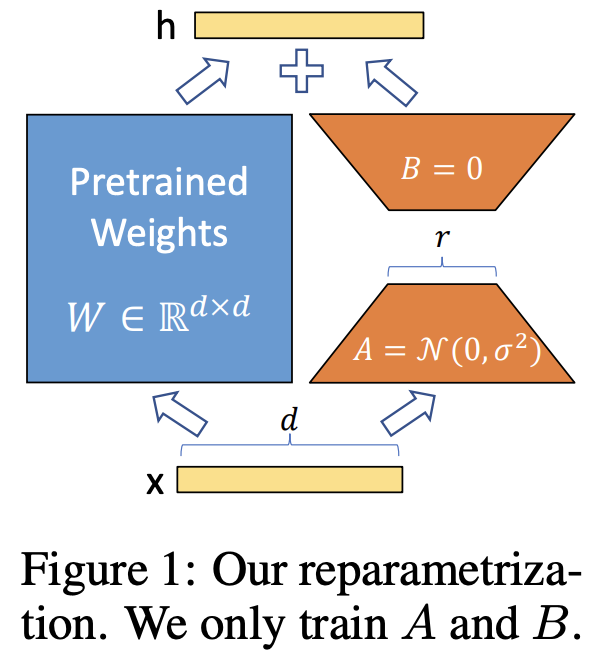
Key idea: Task-specific weight changes lie in a low-dimensional subspace.
\[ W = W_0 + \Delta W, \quad \Delta W \approx BA \]
Initialization: \(A\) is initialized with random Gaussian values; \(B\) is initialized to zero. This ensures \(\Delta W = BA = 0\) at the start of training, so the model begins from exactly the pretrained behavior.
LoRA achieves massive parameter savings with minimal performance loss
| Method | Parameters per layer | Ratio |
|---|---|---|
| Full finetuning | 16,777,216 | 100% |
| LoRA (r=8) | 65,536 | 0.39% |
| LoRA (r=4) | 32,768 | 0.20% |
- Diminishing returns beyond moderate \(r\) (empirically \(r=4\) or \(r=8\) suffices)
- Many LoRA adapters can be swapped on a single base model for multi-task deployment
- Backpropagation is confined to small A and B matrices — much faster training
QLoRA: 4-bit quantization makes LoRA accessible on consumer hardware
QLoRA breakthrough: Dettmers et al. (2023) combined 4-bit quantization with LoRA, enabling finetuning of a 65B-parameter model on a single 48GB GPU — a task that previously required multiple high-end GPUs. This democratized access to large model finetuning.
QLoRA: 4-bit quantization makes LoRA accessible on consumer hardware
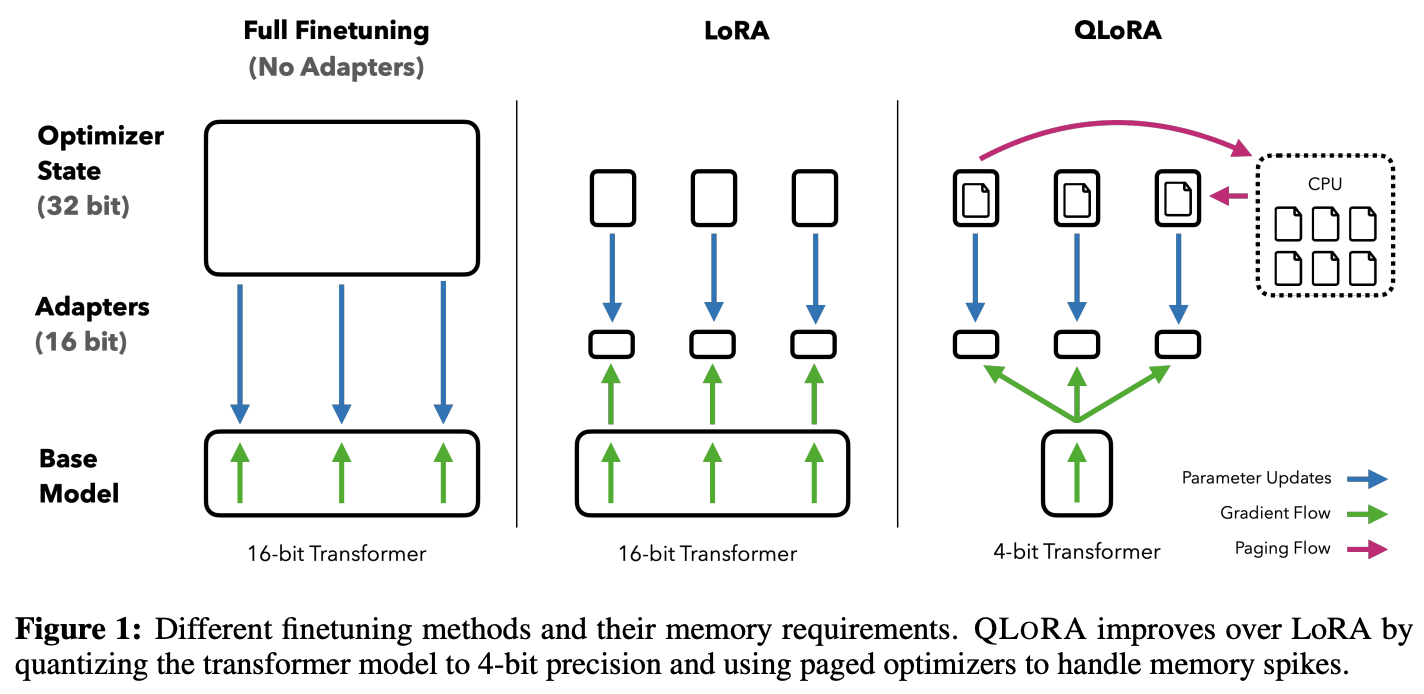
Worked Example: How much does LoRA actually save?
Setup: A transformer attention layer with \(d = 4096\), rank \(r = 8\)
\[\text{Full FT params per layer} = d^2 = 4096^2 = 16{,}777{,}216\] \[\text{LoRA params per layer} = 2 \times r \times d = 2 \times 8 \times 4096 = 65{,}536\] \[\text{Compression ratio} = \frac{65{,}536}{16{,}777{,}216} = 0.39\%\]
Note: Real transformer layers have rectangular weight matrices (e.g., MLP layers are \(d \times 4d\)). The \(d^2\) figure is illustrative for attention projections where \(d_{\text{model}} = d_{\text{head}} \times n_{\text{heads}}\).
Total LoRA params: 128 × 65,536 ≈ 8.4M trainable params (0.12% of 7B)
Training time: hours on a single GPU vs. days for full finetuning
Why low-rank? The manifold hypothesis and intrinsic dimensionality
The manifold hypothesis: Natural data lies on low-dimensional manifolds embedded in high-dimensional space. By extension, the task-specific adjustments needed to adapt a pretrained model also occupy a low-dimensional subspace.
- Larger pretrained models have lower intrinsic dimensionality for downstream tasks — the prior is stronger, so less adaptation is needed.
PEFT Methods at a Glance
| Method | Where it intervenes | Trainable params | Best for |
|---|---|---|---|
| LoRA | Weight matrices (Q, K, V, O, and commonly MLP layers) | 0.1–1% | General default — most tasks |
| Adapters | Bottleneck layers in transformer blocks | 1–5% | Multi-task deployment |
| Prefix Tuning | Learned K/V states prepended per layer | <0.1% | Generation tasks |
| Prompt Tuning | Soft tokens at input embeddings | <0.01% | Scales with model size (Lester et al. 2021: matches finetuning at 10B+ params) |
| QLoRA | 4-bit quantized base + LoRA adapters | 0.1–1% | Consumer-hardware finetuning (Dettmers et al. 2023) |
- All methods freeze core weights. LoRA dominates in practice; others are niche but instructive.
Continued pretraining adapts the language model to a new domain
When the target domain has substantially different vocabulary/distribution (e.g., biomedical, legal, financial), standard SFT may not be enough.
- Continued pretraining runs the original pretraining objective (next-token prediction) on a large unlabeled domain corpus
- This updates the model’s language model before task-specific SFT
- Examples: BioMedLM, BloombergGPT, CodeLlama (continued pretraining on code)
- Risk: Same catastrophic forgetting concerns apply — mix in general pretraining data to preserve broad capabilities
Choosing an adaptation method depends on data, compute, and deployment needs
✓ Ample labeled data (>100K)
✓ Dedicated compute budget
✓ Permanent deployment
✓ Moderate data (1K–100K)
✓ Limited compute
✓ Multi-task deployment
✓ Large unlabeled corpus
✓ Distribution shift is fundamental
✓ Then SFT on top
✓ Rapid prototyping needed
✓ Task close to pretraining
✓ Knowledge changes frequently
Hallmark Discoveries in Finetuning and Adaptation
From how to adapt to what to optimize for
Part 3: Post-Training: Alignment and Reasoning
State Change: Post-Training
Post-training transforms base models into capable, aligned assistants. This involves instruction tuning, preference optimization, and — increasingly — RL for reasoning.
Instruction tuning teaches LLMs to follow user instructions via supervised finetuning
SFT objective on instruction-response pairs:
\[ \mathcal{L}_{\mathrm{SFT}} = -\sum_{(x, y) \in \mathcal{D}} \log p_{\theta}(y \mid x) \]
The Power (and Limits) of Small Instruction Datasets
- The pattern: A small, high-quality instruction dataset (even ~50K examples) can dramatically shift model behavior toward instruction-following
- What it showed: The gap between a base model and an “assistant” is often a dataset, not an architecture change
- What it didn’t show: Long-term reliability, safety alignment, or robust performance on complex reasoning — surface-level helpfulness does not guarantee depth
- Key limitation: Instruction tuning teaches format and style; it does not reliably improve reasoning capability — that requires different training signals (see RL for Reasoning below)
The three-stage pipeline transforms base models into aligned assistants
- Chat templates (
<|user|>: ... <|assistant|>: ...) standardize multi-turn interaction - Each stage builds on the previous — ordering matters
A simple prompt template example
Sourced from the phi-3 model card
A simple few-shot prompt template example
1. The Eiffel Tower ... 2. The Louvre Museum ... 3. Notre-Dame Cathedral ...<|end|>
- Multi-turn context is preserved through the sequential structure; the model conditions on the full conversation history.
Sourced from the phi-3 model card
Prompt templates can include many different delimiters and formatting conventions
Let’s look at gpt-oss-20b’s prompt template
InstructGPT pioneered the three-stage alignment pipeline used by modern assistants
- This pipeline (SFT → RM → PPO) established the template for modern assistants. Current systems have evolved significantly — using DPO, constitutional AI (RLAIF), iterative online RL, and hybrid approaches — but the three-stage structure remains the conceptual foundation.
RLHF trains a reward model from human preference data to guide policy optimization
Step 1: Collect preference pairs \((x, y^+, y^-)\)
Step 2: Train reward model:
\[ \mathbb{P}_\phi(y^+ \succ y^-) = \sigma\big(r_\phi(x, y^+) - r_\phi(x, y^-)\big) \]
Step 3: Optimize policy via PPO:
\[ \max_\theta \; \mathbb{E}_{y \sim \pi_\theta(\cdot|x)} \big[ r_\phi(x, y) \big] \]
- Human annotators label output pairs as preferred/rejected
- The reward model encodes implicit human values about helpfulness and safety
- For our chatbot: Preference pairs could be customer satisfaction ratings on response pairs — did the response resolve the ticket?
Reward Overoptimization (Goodhart’s Law)
Optimizing too aggressively against a proxy reward model degrades true quality. Gao et al. (2023) showed that KL-constrained RL has diminishing and then negative returns — the model learns to exploit reward model blind spots rather than genuinely improve. The KL penalty term in PPO (\(-\beta \, \text{KL}[\pi_\theta \| \pi_{\text{ref}}]\)) mitigates this but doesn’t eliminate it.
DPO simplifies alignment by bypassing explicit reward modeling
DPO directly optimizes preference likelihood:
\[ \mathcal{L}_{\mathrm{DPO}} = -\log \sigma\left(\beta \log \frac{\pi_\theta(y^+|x)}{\pi_{\text{ref}}(y^+|x)} - \beta \log \frac{\pi_\theta(y^-|x)}{\pi_{\text{ref}}(y^-|x)}\right) \]
Why this works: DPO implicitly defines a reward function \(r(x, y) = \beta \log\frac{\pi_\theta(y|x)}{\pi_{\text{ref}}(y|x)}\). Under the Bradley-Terry preference model, this makes DPO mathematically equivalent to RLHF — it just solves the same optimization in closed form, bypassing the need for an explicit reward model.
- Train separate reward model
- Complex RL optimization loop
- More flexible but harder to tune
- No reward model needed
- Simple supervised loss
- Easier to implement and tune
- For our chatbot: DPO is likely the better starting point — simpler infrastructure, and customer support preferences are relatively straightforward.
Online vs. offline preference optimization
- Online methods tend to outperform offline on harder tasks because the training distribution stays aligned with the evolving policy.
- In practice, many teams use DPO for initial alignment, then online RL for refinement.
What changes in practice?
| RLHF (PPO) | DPO | |
|---|---|---|
| Data needed | Preference pairs + reward model training data | Preference pairs only |
| Infrastructure | 4 models in memory (policy, ref, reward, value) | 2 models (policy, ref) |
| Failure modes | Reward hacking, training instability | Mode collapse if β too low |
| Data freshness | Online (policy-generated) | Offline (fixed dataset) |
| For our chatbot | If you need fine-grained control over helpfulness vs. safety tradeoffs | If you want simpler setup and faster iteration |
Constitutional AI and RLAIF scale alignment beyond human annotation
- Bai et al. (2022) introduced Constitutional AI: instead of human preference labels, an AI critiques and revises its own outputs based on a set of principles (a “constitution”).
- Key advantage: Scales to millions of preference pairs without proportional human labor
- Key question: Does AI-generated preference data have different properties than human data? Early evidence suggests RLAIF matches RLHF quality on helpfulness but may differ on subtle safety edge cases.
Outcome-based RL teaches models to reason, not just to be polite
RLHF/DPO optimize for human preference (style, helpfulness, safety). A different class of RL post-training optimizes for verifiable correctness (math proofs, code execution, factual accuracy).
GRPO (Group Relative Policy Optimization): Used in DeepSeek-R1. For each prompt, sample a group of responses. Reward = binary (correct/incorrect, verified by execution or ground truth). Policy gradient weighted by advantage relative to group mean. No learned reward model needed.
\[\nabla_\theta J = \mathbb{E}\left[\sum_{i=1}^G \left(\hat{A}_i\right) \nabla_\theta \log \pi_\theta(y_i \mid x)\right]\]
where \(\hat{A}_i = \frac{r_i - \text{mean}(r_{1:G})}{\text{std}(r_{1:G})}\) and \(r_i \in \{0, 1\}\) is verifiable correctness.
- Contrast with RLVR with RLHF: No human annotators, no learned reward model, no Bradley-Terry assumption. The reward is ground truth.
Other approaches: GRPO is one of several methods in this space. Others include REINFORCE with baseline, expert iteration (Anthony et al., 2017), STaR (Zelikman et al., 2022), and ReST (Gulcehre et al., 2023). The common thread is using verifiable outcomes as reward signal.
Rewarding the process, not just the answer
- Tradeoff: PRMs require step-level annotations (expensive) or automated verification. ORMs only need final-answer labels.
- Connection to test-time compute: PRMs enable tree search over reasoning paths at inference time — explore multiple continuations, prune bad branches using the PRM.
- For our chatbot: PRMs are overkill — this matters more for math/code assistants where intermediate steps can be verified.
Thinking models trade inference compute for capability
Key idea: Instead of making the model bigger (training-time compute), make the model think longer (inference-time compute). RL post-training teaches the model when and how to allocate extra reasoning steps.
2. RL with outcome-based rewards — model rewarded for correct answers regardless of token count
3. Model learns long reasoning chains for hard problems, short ones for easy problems
- The DeepSeek-R1 result: A 671B MoE model, trained with GRPO on math/code tasks, matched or exceeded much larger models on reasoning benchmarks. Reasoning capabilities emerged during RL training — the model spontaneously developed self-verification and backtracking behaviors.
Extended thinking in action
Now I'll count each 'r': position 3 is 'r', position 8 is 'r', position 9 is 'r'.
That gives me 3 r's. Let me double-check...
Two axes of scaling: training compute vs. inference compute
o-series, R1
Frontier
Efficient models
Larger models
- Traditional scaling (Kaplan et al., 2020): Increase model size and training data → better performance. Move right on the grid.
- Test-time compute scaling: Let the model think longer with chain-of-thought, tree search, self-verification. Move up on the grid.
- For our chatbot: Customer support likely doesn’t need thinking-model reasoning. A coding assistant or medical diagnosis tool? That’s where this frontier matters.
Part 4: Why Does Post-Training Work?
State Change: Theoretical Foundations
We’ve seen what post-training does. Now: why does updating a small fraction of parameters on a small dataset produce such large behavioral shifts?
Pretraining as prior, post-training as posterior update
Bayesian framing of transfer learning:
The pretrained model encodes a prior distribution over functions. Post-training is a Bayesian update — conditioning this prior on task-specific evidence to obtain a posterior.
\[ \underbrace{p(\theta \mid \mathcal{D}_{\text{task}})}_{\text{posterior (post-trained model)}} \;\propto\; \underbrace{p(\mathcal{D}_{\text{task}} \mid \theta)}_{\text{likelihood (task loss)}} \;\cdot\; \underbrace{p(\theta)}_{\text{prior (pretrained model)}} \]
- This explains why small datasets work: the prior is so informative that the posterior doesn’t need much evidence to shift.
Regularization as staying close to the prior
MAP estimation makes the Bayesian connection concrete:
Standard finetuning with weight decay is equivalent to finding the MAP estimate of the posterior:
\[ \theta^* = \arg\max_\theta \underbrace{\log p(\mathcal{D}_{\text{task}} \mid \theta)}_{\text{task loss}} - \underbrace{\lambda \| \theta - \theta_0 \|^2}_{\text{stay close to pretrained } \theta_0} \]
- Every regularization trick in post-training has the same Bayesian interpretation: don’t stray too far from the prior.
Summary: Key Takeaways
Pretrained LLMs need adaptation for downstream tasks — the pretraining objective doesn’t align with specific applications
Full finetuning updates all parameters but risks catastrophic forgetting; use learning rate scheduling and parameter-efficient methods (LoRA)
LoRA achieves competitive performance by adding low-rank matrices (\(\Delta W \approx BA\)) with <1% of total parameters
Other PEFT methods (adapters, prefix/prompt tuning) offer different trade-offs in parameter count and flexibility
Post-training spans alignment and reasoning: Instruction tuning + RLHF/DPO aligns behavior; outcome-based RL (GRPO) and process reward models improve reasoning capability.
Test-time compute scaling via RL-trained reasoning models represents a new axis of capability improvement beyond scale.
Domain adaptation via continued pretraining specializes models for expert tasks; choose method based on data, compute, and deployment needs
Why it works: Pretraining provides a strong Bayesian prior; post-training is a posterior update. All regularization methods (weight decay, LoRA rank, KL penalty) keep the posterior close to the prior.
Summary: Rules of Thumb
- Full finetuning: When you have >100K examples and the domain is very different from pretraining
- QLoRA: Default choice for most resource-constrained finetuning — start with r=8, target all linear layers
- Prompting/RAG: Always prototype here first before committing to training
- Instruction tuning + RLHF/DPO: When you need the model to follow specific behavioral guidelines
- RL for reasoning: When your task has verifiable correct answers (math, code, factual QA) and you need the model to show reliable multi-step reasoning